MU Director to Arab Strategy Forum: Social Media Aren’t Just for Kids

Catch the wave and ride it, don’t sink under it, Media Unlimited director Magda Abu-Fadil told participants at the Arab Strategy Forum 2013 in Dubai.

Arab Strategy Forum 2013 logo

Arab Strategy Forum 2013 logo

“We can’t operate in the media with a Stone Age mentality,” she insisted. “Social media aren’t just for kids.”

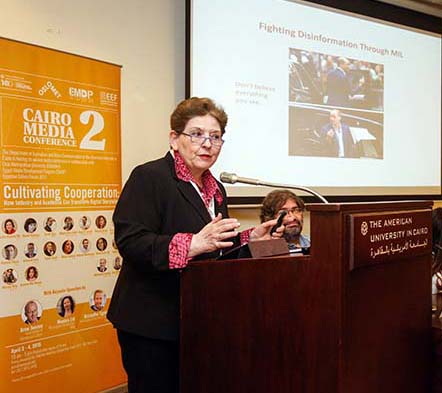
To prove the point and debunk traditionalists’ thinking, she spoke, tweeted and shot video during her session on the relationship between Arab media and social networks.

Abu-Fadil speaks, tweets and shoots video at ASF 2013

Abu-Fadil speaks, tweets and shoots video at ASF 2013

She also said there was a lot of useful information online.

But equally important is the ability to use critical thinking to filter through all the disinformation and misleading content, she added.

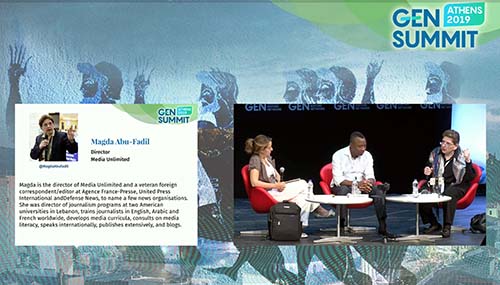
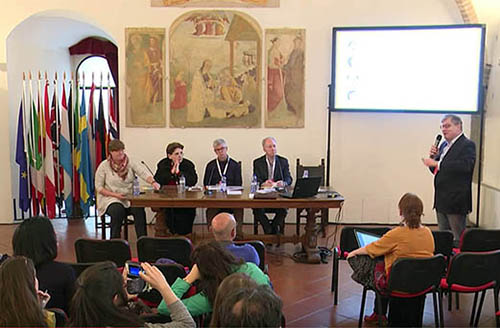
Arab media and social networks panel

Arab media and social networks panel

The forum, organized by the Mohammed bin Rashid Al Maktoum Foundation (MBRF), grouped experts from across the Arab world and United States who discussed social networks and knowledge society.

MBRF CEO Sultan Ali Lootah opens ASF 2013

MBRF CEO Sultan Ali Lootah opens ASF 2013

They included Charbel Fakhoury, Microsoft’s vice president for sales and marketing in the Middle East, Mohamed Murad from Google Gulf, Kaveh Gharib from Twitter’s U.S. headquarters and Jonathan Labin from Facebook’s Middle East and Africa arm.

Dubai TV's Zeina Yazigi (right) chairs "Evolution of Social Networks" session

Dubai TV’s Zeina Yazigi (right) chairs “Evolution of Social Networks” session

Also on hand for the two-day forum in March 2013 were Saudi bloggers Molook Al Sheikh and Abdel Aziz Al Shaalan, Bahraini TV host Khaled Al Shaer, and Kuwaiti columnist Meshal Al Nami.

Emirati speakers filled the “Tweet Positively” panel that concentrated on religious aspects and positive values in uses of social networks, as well as individuals’ roles in protecting their nation from harmful media, and how to use Twitter for good causes.

Accuracy key to good journalism: Abu-Fadil

Getting it right topped the list of tips Media Unlimited director Magda Abu-Fadil offered journalists at Al Arabiya’s English website during an informal chat in Dubai.

Magda Abu-Fadil addresses Al Arabiya’s English website team

Magda Abu-Fadil addresses Al Arabiya’s English website team

Abu-Fadil said elementary rules like spelling people’s names correctly and ensuring their titles were precise should not be overlooked since they were the corner stones of good reporting.

She also cautioned participants, several of whom she trained in October 2012, not to rush and publish information before verifying it from multiple sources, noting that rumors and other questionable news and visuals filled the Internet, leading to many a journalist’s downfall.

Abu-Fadil recounted some of her adventures as a foreign correspondent and editor and how she had transitioned from being a traditional journalist to a blogger and media trainer.

Abu-Fadil with Al Arabiya English website editor in chief Faisal Abbas

Abu-Fadil with Al Arabiya English website editor in chief Faisal Abbas

The event dubbed “Accuracy: How it could make us, or break us,” was part of an Al Arabiya English website General Assembly in March 2013.

The Middle East in Transition: What Future for Arab Youth?

Arab Youth are more concerned about fair pay, home ownership and a decent life than democracy, Media Unlimited director Magda Abu-Fadil told students at Sciences Po – Menton in the south of France.

The rising cost of living was a major concern although the lack of democracy and civil unrest were also seen as obstacles to progress, she said quoting the ASDA’A Burson-Marsteller Arab Youth Survey 2012 that analyzed data from 12 countries.

The study also revealed that while a majority of young people agreed traditional values were paramount, an increasing number of them said such values were outdated and should be replaced.

Magda Abu-Fadil on Arab youth prospects with Sciences Po-Menton director Bernard El-Ghoul and students

Creating jobs for a growing Arab youth population is a major challenge for decision makers following the outbreak of revolutions in a number of the region’s countries.

Demographic issues such as high population growth and pressures on labor markets compound the problem, Abu-Fadil said.

She also discussed young people’s contribution to revolutions gripping the Arab world and what prompted them to take to the streets.

The role social media played in the various uprisings was another topic of discussion, with Abu-Fadil explaining that such tools were not the ultimate influencers in these movements given the high rate of illiteracy and uneven access to the Internet.

Although prospects may appear dim, education reform could be an answer, with emphasis on critical thinking and the revisiting of school and university curricula to meet employers’ requirements.

The discussion in January 2013 was part of a week-long orientation program at the Middle East/Mediterranean campus of Sciences Po aimed at familiarizing students with the university’s undergraduate and graduate studies, life in the Middle East, and exchange programs available to them.


Abu-Fadil Dissects Media Accountability in Lebanon

How much media accountability is there in Lebanon? Are media accountable and do they hold officials accountable?

It’s a double-edged sword that cuts both ways, said Media Unlimited Director Magda Abu-Fadil, adding that laws and codes of ethics are not implemented, loosely implemented, or totally ignored, depending on the issue at stake, politics involved, and persons influencing them.

Magda Abu-Fadil on media accountability in Lebanon

She dissected Lebanon’s antiquated print and broadcast media laws that require major overhaul.

In a presentation on accountability at a forum organized by Media Act in Toulouse, France, Abu-Fadil pointed to Lebanese legislator Ghassan Moukheiber’s Media Reform Bill aimed at shrinking the existing 109 provisions of the 1962 print law to 75.

According to Moukheiber, almost 80% of his draft bill’s provisions have been approved in the parliamentary committee discussing the matter.

Another draft bill on broadcast media put forward by Moukheiber would see the strengthening of the National Audio-Visual Media Council as a regulatory body.

Lebanese legislator Ghassan Moukheiber

It’s currently a toothless tiger of elected and appointed members along sectarian lines.

A very important draft bill on access to information has also passed the test, but all three bills have yet to be voted into law.

Abu-Fadil reviewed media-related events in 2012 and Lebanese print and broadcast journalists’ efforts to establish a stronger union presence.

She also discussed press freedom monitoring efforts by various local and international organizations, attempts to muzzle the media and whether Lebanon was immune to the “Arab Spring.”

The Media Act forum in January 2013 entitled “Media Accountability in Transition: Insights from the Arab World” was organized jointly by the German Erich-Brost-Institut at Dortmund University, the French Institut d’Etudes Politiques de Toulouse, and Paris II University.

Profs. Olivier Baisnée of IEP Toulouse and Judith Pies of Dortmund University

It grouped experts from Germany, France, Italy, Britain, Poland, Egypt, Algeria, Morocco and Lebanon who reviewed potentials for media accountability in Jordan and Tunisia as well prospects in Egypt and Morocco.

Dubai Press Club Google Hangout Reviews Arab Journalism Award

Seven journalism aficionados rounded up 2012 events with a Google Hangout session to review the Arab Journalism Award’s (AJA) development and impact.

AJA judges and recipients discussed the Arabic language as a standard for evaluating published materials, the importance of keeping up with technological advances, and the evolution of social and digital media as inseparable parts of journalism ahead of the award’s 12th run in May 2013.

The virtual meeting dubbed “Journey to Honor Creativity” was chaired December 30 by the AJA’s manager Muna Busamra to feature the award’s growing importance in the Arab world and its effect on the region’s journalists.

Arab Journalism Award manager Muna Busamra

Participants included Saudi media researcher Fahed Al Harithi, Saudi journalist Nahed Bashatah (one of the first women to be honored), Egyptian journalist/recipient Ali Zalat, Egyptian journalist/recipient Walaa Nabil, Emirati journalist/recipient Mohammad Aljoker, and Media Unlimited director Magda Abu-Fadil.

Abu-Fadil, a former board member and panel judge of the AJA, was instrumental in introducing investigative and online journalism categories to the award.

MU director reviews AJA merits

She also stressed the importance of regular training for journalists to ensure their skills remain up to par in a fast-changing media landscape.

The Arab Journalism Award is administered by the Dubai Press Club under the patronage of Sheikh Mohammad Bin Rashed Al Maktoum. Prizes are traditionally awarded at the end of the annual Arab Media Forum in Dubai.


Arab Women Beat Men on Twitter: Sayyidati

Arab women are making great strides in their use of social media, often outrunning their male counterparts on Twitter, according to studies.

The shift from traditional to digital, social and interactive media is a natural for women, notably in the Arab world where conservative societies have been slow to accept females in high visibility roles, Media Unlimited director Magda Abu-Fadil said.

“Thanks to such media, you feel women have a presence, are speaking out more, communicating more, interacting more with their societies, and perhaps with people they don’t even know, and have proved themselves,” she told Maysaa Al Amoudi on the Rotana satellite channel show “Sayyidati” (My Lady).

Women have been able to reach far wider audiences than they would through traditional media, she explained, adding that they have to develop by mastering different social media tools and platforms.

Abu-Fadil on “Hewar Al Arab”: Twitter is key

Media Unlimited director Magda Abu-Fadil urged critics to reconsider their reluctance to use Twitter and better engage audiences through this social medium, given its growing importance in the Arab world.

She argued in favor of young tweeps and journalists, despite misuses of the platform, adding that Twitter had become a source of news and information that should not be ignored.

Magda Abu-Fadil on "Hewar Al Arab"

Abu-Fadil noted Arab journalists’ increased use of Twitter in the last couple of years but said they were still hesitant to capitalize on it as a news resource.

She said international news organizations had initiated codes of conduct for social media uses in addition to their traditional media guidelines for good journalistic practice.

Her views were aired on Al Arabiya satellite channel’s show “Hewar Al Arab” in an episode dedicated to “Twitter Communities.”

The program, hosted by Muntaha Al Ramahi, grouped tweeps Abdallah Shaalan and Moulouk Al Sheikh as well as academic Sadek Al Hamami.

MENA Journalism Teaching & Training Need Professional Boost

Journalism education and training in the MENA region need a shot in the arm to ensure graduates and practitioners attain and maintain professional standards, students at the University of Wollongong in Dubai were told.

“Journalists are like emergency room doctors,” Media Unlimited director Magda Abu-Fadil said, addressing a joint class of postgraduate students in the Master of Media and Communications and Master of International Studies programs in October 2012.

They treat and save (news) patients, work on tight deadlines, can’t afford to make mistakes, and if they do, the results could be catastrophic, she explained.

Magda Abu-Fadil addresses master classes at University of Wollongong in Dubai

Abu-Fadil said there was often a “disconnect” between what is taught and what the journalism market needs, given the fast-changing landscape, globalized nature of the industry, and introduction of digital technologies in all facets of the profession.

On the academic front, Abu-Fadil noted the lack of up-to-date courses, newsrooms and regular student on-campus newspapers, radio and/or TV stations and websites in most Arab countries.

“The introduction of online journalism courses has been very slow,” she noted, adding that she had co-authored the UNESCO-sponsored book “Model Curricula for Journalism Education” as a template for developing countries, which is available in nine languages.

She lamented the lack of attention to the learning of languages, geography and history, notably for journalists choosing careers as foreign correspondents, and said traditional Arab curricula do not encourage critical thinking.

On another front, Abu-Fadil advised the students not to be satisfied with their degrees but to seek regular training to upgrade and update their knowledge and skills.

She underlined the importance of ethical media practices, attention to detail, inclusion of context in all stories, and, the importance of integrating multimedia and social media in their coverage.


MU Speaks Out on Need for Better Journalism Teaching/Training at Dubai’s 11th Arab Media Forum

Media Unlimited director Magda Abu-Fadil told participants at an Arab Media Forum (AMF) 2012 workshop that academics must get up to speed and not deride the importance of social media.

Some panelists and members of the audience said online media users could not be described as journalists since they don’t have the requisite academic and professional qualifications.

Magda Abu-Fadil (second from right) during AMF2012 workshop on instinctive online journalists (Courtesy of DPC)

But, Abu-Fadil argued, many Arab journalism schools lacked resources and because of their poor curricula were turning out functional illiterates by not providing students with the knowledge base and skills for today’s exploding media market.

Additionally, faculty members were often below par and incapable of keeping up with the times, hence their aversion to digital advances, social media, and inability to incorporate them in their programs.

Media Unlimited featured at Arab Media Forum 2012 in Dubai (Courtesy of DPC)

The workshop — which preceded the two-day event’s official opening — focused on whether social and online media users had become journalists by instinct.

Talk show host Zeina Yazigi (Twitter @zyazigi) of Dubai TV interviewed Abu-Fadil on her show “Al Shari’ Al Arabi” (The Arab Street) to discuss the impact of online and social media on Arabs in the wake of revolutions gripping the region and whether citizen journalists posed serious competition to traditional media.

Read details of the 11th Arab Media Forum organized by the Dubai Press Club May 8-9, 2012.


Magda Abu-Fadil: Tunisia’s Social Media, Slip in Freedom on Al Hurra TV

Tunisian activists fear post-revolution gains may be slipping due to pressures and threats from hardline Islamists and supporters of the ruling Annahda Party, Media Unlimited director Magda Abu-Fadil told Washington-based Al Hurra TV in an interview from Beirut.

Abu-Fadil had referred to activists like Slim Amamou in a Huffington Post piece and reiterated his and others’ concerns about restrictive controls on traditional and online media.

Magda Abu-Fadil interviewed by Al Hurra TV

Asked how Annahda could fight social media when the party was using such tools to disseminate its message, Abu-Fadil replied: “Attacks or piracy are often used by regimes to counter adversaries.”

She added that oppressive governments often resorted to various measures to promote their ideas and attack opponents such as bloggers, activists and journalists who seek a wider margin of freedom in their countries.

“Social media are a necessity for all,” Abu-Fadil said on B-Link, a segment of the Al Hurra show “Al Youm.”