Tripoli Trainees Jump on Citizen Journalism Bandwagon

Fourteen trainees learned how to become citizen journalists while maintaining professional and ethical standards during a workshop organized by the Lebanese Center for Active Citizenship.

The training in December 2012, funded by the U.S. Agency for International Development, touched on the evolution of modern journalism and how it gave rise to the form today practiced by ordinary citizens.

The Importance of Twitter in citizen journalism

Trainees acquired skills to help with effective coverage of events, through live blogging and vlogging, geographic positioning, and the importance of social media in instant dissemination of news.

Media Unlimited director Magda Abu-Fadil conducted the short course in the northern Lebanese city of Tripoli that grouped 12 mass communication students from Al Jinan University and two social activists.

Magda Abu-Fadil with LCAC officials and trainees

Abu-Fadil advised the participants to keep their content short and clear, to use active verbs, to make sure their headlines are relevant and attractive, and, to use key words for easy search engine optimization.

She also stressed the importance of good visuals like photos and videos as well as infographics and simple language.

The attraction of photos and captions

Participants also discussed media standards and ethics with Abu-Fadil reminding them to be accurate, balanced, transparent, truthful, and not to lose sight of context.
Lebanese Students Taste Investigative Journalism

Twenty-one students got an introduction to investigative journalism and its role in enhancing citizenship at a workshop in Lebanon’s northern port city of Tripoli.

The one-day training involved definitions of investigative journalism, duties and responsibilities of investigative journalists, and how to become reporters covering that beat.

MU director with AUT, LCAC officials and students

Participants were also briefed on how to dig for information, ideas that could be developed into investigative reporting projects, computer-assisted research and reporting (a/k/a data-driven journalism), and skills to evaluate documents and figures.

A final session was dedicated to interviewing techniques and media ethics.

The workshop in November 2012 was conducted by Media Unlimited director Magda Abu-Fadil and organized by the Lebanese Center for Active Citizenship as part of the latter’s “Our Right to Know” campaign.

Abu-Fadil explains fine points of investigative journalism

The students hailed mainly from the American University of Technology’s  Tripoli and Halat campuses. A lawyer/student and a reporter from Beirut also joined the group.

Arab Women Beat Men on Twitter: Sayyidati

Arab women are making great strides in their use of social media, often outrunning their male counterparts on Twitter, according to studies.

The shift from traditional to digital, social and interactive media is a natural for women, notably in the Arab world where conservative societies have been slow to accept females in high visibility roles, Media Unlimited director Magda Abu-Fadil said.

“Thanks to such media, you feel women have a presence, are speaking out more, communicating more, interacting more with their societies, and perhaps with people they don’t even know, and have proved themselves,” she told Maysaa Al Amoudi on the Rotana satellite channel show “Sayyidati” (My Lady).

Women have been able to reach far wider audiences than they would through traditional media, she explained, adding that they have to develop by mastering different social media tools and platforms.

MU Leads UAE Investigative Journalism Training

Over 50 UAE-based journalists feel better equipped to tackle investigative assignments after two intensive courses conducted by Media Unlimited director Magda Abu-Fadil.

“As a general introduction to investigative journalism, procedures and information, it was suitable, but for implementation, one needs more time, which we hope to get (in the future),” said one of the participants.

Abu Dhabi Investigative Journalism Group

It was an eye opener for reporters and editors in Abu Dhabi and Dubai, who attended workshops in November 2012 aimed at sharpening their skills in what is known as data-driven journalism.

The workshop focused on ethics in investigative journalism, ideas for topics to cover, digging for information, use of documents and numbers, and, computer-assisted reporting.

Abu-Fadil explains investigative reporting elements in Abu Dhabi

Reporters and editors from various newspapers and media-related fields attending the  course also learned how to combine text with visuals and how to incorporate social media in their projects.

Abu-Fadil in Dubai describes blogs' uses in investigative journalism

The training was organized courtesy of the UAE Journalists Association, the U.S. Embassy in the UAE and the telecommunications company Etisalat.

Dubai Investigative Journalism Workshop Trainer & Trainees

“I benefited on a personal and professional level from this workshop that will have an impact on my work,” said Mohammad Abdel Rasheed from the daily Al Bayan.

Both groups viewed the Watergate scandal classic “All the President’s Men” starring Robert Redford and Dustin Hoffman to get a taste of old-fashioned investigative reporting techniques.

Abu-Fadil on “Hewar Al Arab”: Twitter is key

Media Unlimited director Magda Abu-Fadil urged critics to reconsider their reluctance to use Twitter and better engage audiences through this social medium, given its growing importance in the Arab world.

She argued in favor of young tweeps and journalists, despite misuses of the platform, adding that Twitter had become a source of news and information that should not be ignored.

Magda Abu-Fadil on "Hewar Al Arab"

Abu-Fadil noted Arab journalists’ increased use of Twitter in the last couple of years but said they were still hesitant to capitalize on it as a news resource.

She said international news organizations had initiated codes of conduct for social media uses in addition to their traditional media guidelines for good journalistic practice.

Her views were aired on Al Arabiya satellite channel’s show “Hewar Al Arab” in an episode dedicated to “Twitter Communities.”

The program, hosted by Muntaha Al Ramahi, grouped tweeps Abdallah Shaalan and Moulouk Al Sheikh as well as academic Sadek Al Hamami.

MU Beefs Up Al Arabiya English Journalists’ Abilities

Media Unlimited director Magda Abu-Fadil drilled four members of  Al Arabiya’s English website team in journalism basics, components of news stories and tested their general knowledge in politics, geography, history and mathematics.

Exercises included strengthening story leads, avoidance of redundancies, aversion to oxymorons, and common errors journalists make when writing English copy.

Magda Abu-Fadil and Al Arabiya English website team

She conducted the four-day course in intensive journalism for select members of the satellite news channel  at their Dubai headquarters.

The budding journalists learned about setting news priorities by understanding newsworthiness and how to categorize stories in their daily lineups.

Members of Al Arabiya English web team

They also picked up tips on good feature, long story and series writing, as well as efficient ways of digging for information using traditional and online resources.

Abu-Fadil reinforced their ability to find, cultivate and use sources for their stories and how to measure the sources’ credibility.

Profiles, news conferences, speeches, meetings and interviews were part of the October 2012 workshop, as was beat reporting and editorializing.

The journalists were also urged not to overlook media ethics and to engage their audiences more actively through social media.

MENA Journalism Teaching & Training Need Professional Boost

Journalism education and training in the MENA region need a shot in the arm to ensure graduates and practitioners attain and maintain professional standards, students at the University of Wollongong in Dubai were told.

“Journalists are like emergency room doctors,” Media Unlimited director Magda Abu-Fadil said, addressing a joint class of postgraduate students in the Master of Media and Communications and Master of International Studies programs in October 2012.

They treat and save (news) patients, work on tight deadlines, can’t afford to make mistakes, and if they do, the results could be catastrophic, she explained.

Magda Abu-Fadil addresses master classes at University of Wollongong in Dubai

Abu-Fadil said there was often a “disconnect” between what is taught and what the journalism market needs, given the fast-changing landscape, globalized nature of the industry, and introduction of digital technologies in all facets of the profession.

On the academic front, Abu-Fadil noted the lack of up-to-date courses, newsrooms and regular student on-campus newspapers, radio and/or TV stations and websites in most Arab countries.

“The introduction of online journalism courses has been very slow,” she noted, adding that she had co-authored the UNESCO-sponsored book “Model Curricula for Journalism Education” as a template for developing countries, which is available in nine languages.

She lamented the lack of attention to the learning of languages, geography and history, notably for journalists choosing careers as foreign correspondents, and said traditional Arab curricula do not encourage critical thinking.

On another front, Abu-Fadil advised the students not to be satisfied with their degrees but to seek regular training to upgrade and update their knowledge and skills.

She underlined the importance of ethical media practices, attention to detail, inclusion of context in all stories, and, the importance of integrating multimedia and social media in their coverage.


Anba Moscow/Ria Novosti Journalists Upgrade Agency Online Skills

Seven journalists at Anba Moscow’s Dubai bureau underwent intensive training to upgrade their skills for the website maintained in Arabic by the Russian news agency Ria Novosti.

The journalists, who come from diverse backgrounds, attended a five-day workshop in October 2012 conducted by Media Unlimited director Magda Abu-Fadil on the needs of an international news agency, evolution of the media, and story structure in an online environment.

Anba Moscow trainees upgrade news agency online skills

Also on the agenda was the importance of solid headlines and leads, sources, types of wire stories and integration of social media into the mix for better audience engagement.

Magda Abu-Fadil with Anba Moscow team in Dubai

Abu-Fadil reminded the journalists of the need to maintain high ethical standards in their coverage.

They were provided tips on crises, sudden events, fieldwork, means of communication, safety measures and coordination between correspondents and their newsrooms.

Not to be overlooked, the Anba Moscow team was encouraged to make good use of infographics, photos, videos and audio clips, and develop interest in multimedia.

Qatar educators learn to integrate media literacy into curricula

Seventy-eight Qatar-based educators from 42 schools took part in media literacy workshops in October 2012 to become more communicative by engaging their students across various platforms.

“I really enjoyed this workshop that helped expand my horizons regarding media literacy,” said Nihal Azmi, one of the participants in the three one-day training sessions organized by the Doha Center for Media Freedom.

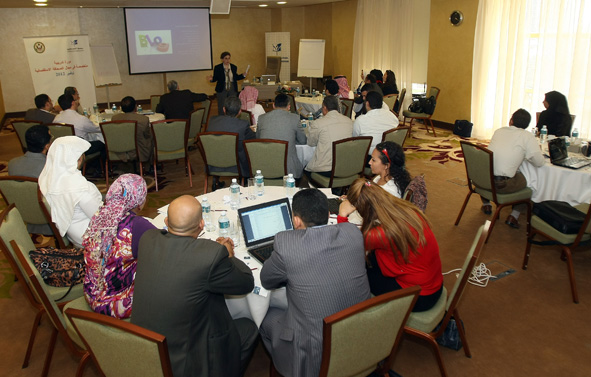
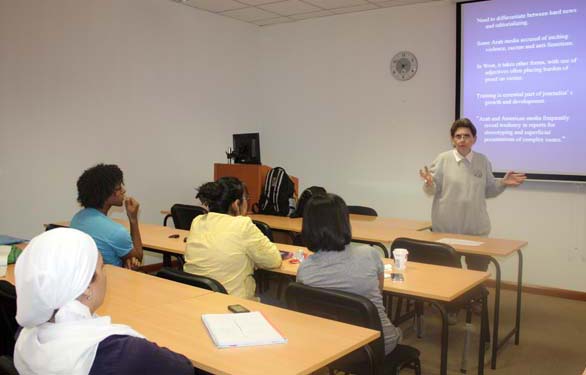
Qatar teachers attend first of media literacy workshop series in October (DCMF)

The training by Media Unlimited director Magda Abu-Fadil introduced the primary-to-secondary school teachers and coordinators to UNESCO’s “Media and Information Literacy: Curriculum for Teachers,” an invaluable reference available in four languages.

The book, aimed primarily at teachers, features the convergence of radio, television, the Internet, newspapers, books, digital archives and libraries into one platform to define media literacy in a holistic manner.

Abu-Fadil urged the teachers to learn their students’ language and used Lebanese private school International College as a case study of an educational institution that has incorporated media literacy in all its subjects.

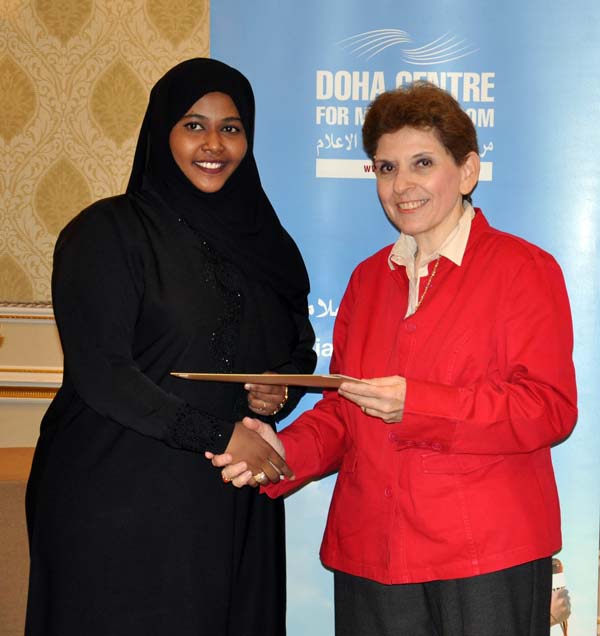
Magda Abu-Fadil hands certificate to Media Literacy workshop participant in Doha (DCMF)

Abu-Fadil also briefed participants on the media’s evolution from traditional print and broadcast organizations to online outlets and social media that are the preferred vehicles for students

“The workshop was useful and valuable. I suggest we have one annually to keep up with developments,” said another participant.

The teachers saw a need for more specific training to help them translate their understanding of media and the requisite tools to applicable skills in the classroom with a number calling for follow-up workshops.

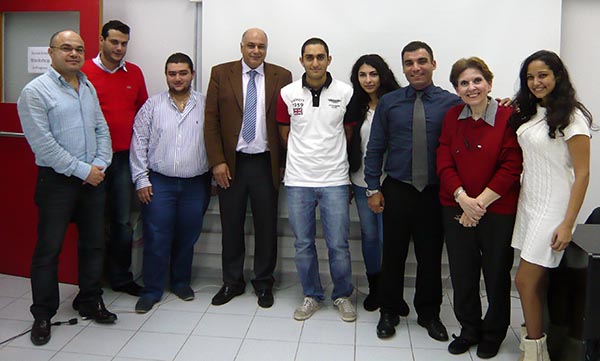
Participants and DCMF staffers flank MU director at Media Literacy workshop (DCMF)

Links to coverage by the Doha Center for Media Freedom:

http://www.youtube.com/watch?v=DKcDAC_KkwY&feature=plcp    

http://www.youtube.com/watch?v=aTMr-fMTJgA&feature=plcp    

http://www.youtube.com/watch?v=H1CV8lfpFx0&feature=plcp

KUNA Journalists Learn How to Become Foreign Correspondents

Six Kuwait News Agency (KUNA) journalists were plunged into an intensive workshop on how to become foreign correspondents, including risks involved, news priorities, the organization and management of foreign bureaus, and how to tie their overseas coverage to local events.

KUNA's future foreign correspondents

Media Unlimited director Magda Abu-Fadil conducted the five-day course in October 2012 at KUNA headquarters in Kuwait during which participants also learned about the importance of being multimedia reporters able to handle photography and video journalism.

Not to be overlooked are social media that should be incorporated into the mix, Abu-Fadil told her charges, to secure greater audience engagement.

Magda Abu-Fadil with KUNA trainees in Kuwait

The reporters were also briefed on how to build their list of foreign contacts, databases, equipment needed for assignments, communication gear, sources, safety measures during crises and attempts to censor them by foreign governments.

They learned the key to a smooth operation is good coordination between the correspondents and bureaus, and, the newsroom.